
New Haven, CT
New Haven is a city of many divides. Kenneth Burke wrote a piece of literary criticism about Shakespeare’s The Tragedy of Coriolanus entitled “The Delight in Factions,” in which he suggests that all social apparatus are vehicles for satisfying mankind’s natural, albeit ugly, delight in factions––creating us vs. them and in-group vs. out-group dynamics. We like to think we’re social beings, or at least not as overtly antisocial as Shakespeare makes us out to be, but as modern social tensions make clear, Burke is probably right. Case in point, the city of New Haven.


Background
I went to Yale College, located in downtown New Haven. At freshmen orientation we were told not to go past College Street, the outer boundary of Yale’s Old Campus. Town-gown relations are complicated. It’s Yale students v. New Haven residents. Worse, even, is the split between Yale worker unions composed of residents vs. Yale administration vs. city government and vs. developers vs. vs. vs. There’s just a lot of social tension for a city of New Haven’s size (it’s only about 20 square miles with a population around 130,000).
I wrote my thesis on Coriolanus but had spent the majority of my time at Yale writing about the intoxicating adhesiveness of the poetry of Walt Whitman. I’m about people coming together. Over food, over literature. Togetherness is hard, because it’s about balancing self-awareness and social harmony.
As a graduation present and final test for myself, I wanted to validate my liberal arts college ideals against hard facts. I wanted to see if words and actions could actually change attitudes, and if so, which words and what kind of actions?
I needed to an excuse, a way to channel these thoughts into practical action. I needed a project. I also needed to fill a month while I waited for my student visa to be approved before I could move to Spain for a fellowship.
Brunch
Brunch is kind of the 21st century’s universal sign of social harmony. How do you know when adversaries have made amends? They’re smiling over baked goods and orange juice at brunch.
Brunch is also easy. Eggs and potatoes are inexpensive and can be dressed up in any number of fun ways. French toast is also inexpensive and can be made classy with just a few creative enhancements.

What if…
If you build it, will they come? Will they enjoy? Will they socialize?
What if I had a really long communal dining table, like the one in the Saybrook College dining hall, and I made brunch and invited everyone and anyone in town over for brunch? Would people come? Would they pull up a chair and feel welcome among strangers, strangers who were also taking a chance on a social experiment? What kinds of conversations would happen that otherwise wouldn’t? Who would meet whom by chance?
The calculus, I hoped would paint the experience as at low stakes, high gain gamble––spend an hour at a communal table for a $20 prix fixe brunch buffet, talk, hang out, get to know strangers to your right, left, across the table, etc. If nothing else, you’ll have had my bananas foster french toast made for you.
I just did it
I didn’t think very much. I was 22. I had just graduated from college. I had just gotten my first credit card and needed to spend money to get my sweetheart deal points. And I had to wait a month for student visa to be approved. So I just did it. I put together a pop up brunch restaurant to run a social experiment.
I’d pop up in an empty restaurant space that had a commercial kitchen. I’d advertise on Facebook and presell tickets on EventBrite. I’d buy eggs and potatoes in bulk at Costco and then fresh produce from local farmers at the Farmers Markets.
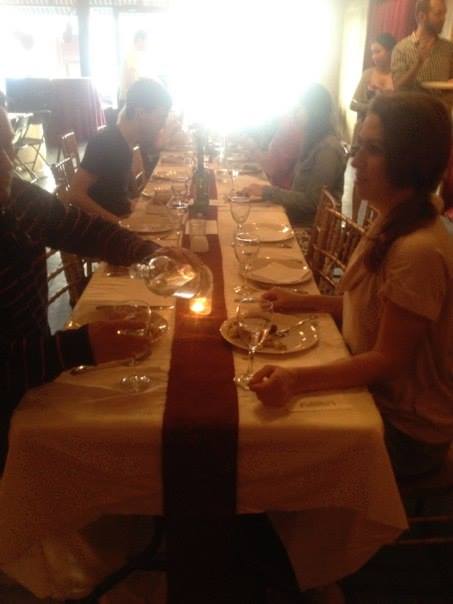
I’d put together tables, drape a table cloth, and decorate with empty wine bottles and dried flowers, and borrow plates and flatware from a restaurant that was closed on Sundays anyways.
I’d cook food, place it right on the table family style, and watch my guests interact.


The result
- Served 130 people over the course of three Sundays brunch dates
- Spent about $1,000 on food and decorations and made $3,300 in ticket sales and day-of upsells (coffee, corkage, special requests).
- Saw Yale professors, graduate students, undergrads, New Haven townies, and a mix of random other New Haven transplants talk to each other and break bread.
- Made dozens of new friends.
Takeaway: brunch brings people together–-the question thereafter is how to harness and leverage the togetherness to make or do something. If nothing else, I learned that I am capable of orchestrating and building community. It’s in me and comes naturally to me. And if nothing else came of the experience, I proved to myself that having read poetry and written about Shakespeare at Yale was not a waste––it taught me, and I proved to myself, that action is eloquence.
 Katherine McComic